

Startup Strategy: Red Ocean vs Blue Ocean
The minds behind the Red Ocean Strategy and Blue Ocean Strategy created these based on surveying and studying startups. Over 100 startups took part in that survey to discover the outcomes of their startup strategy choice.
- 86% followed the red ocean strategy.
- Only 14% opted for the blue ocean strategy.
Importantly, both the Red Ocean and Blue Ocean startups in the study were successful. The outcome of choosing the right startup strategy was mainly in profits.
- 39% of profits belonged to red ocean startups which were 86% of the pool.
- 61% of profits went to 14% of blue ocean startups.
So, you can succeed with both strategies. But why the Red Ocean strategy is more widely adopted? And, why does the Blue Ocean strategy generate more profits? More importantly, what even are these ocean strategies? And, lastly, what should you choose for your next digital startup?
After all, whether consciously or not, any business startup follows some strategy. For example:
- You choose a known market but find cheaper sourcing – you are said to follow a traditional (red ocean) strategy.
- If you find an unmet need in a segment of an existing market – you are said to follow a niche strategy.
- If you decide to invent a new technology to replace the old one – you are likely to be a disruptor.
- You create an offering that does not really fall within any market but rather spans a few of them – you are said to have found a blue ocean.
Table of contents

Red Ocean vs Blue Ocean: Definition
“The only way to beat the competition is to stop trying to beat the competition. Imagine a market universe composed of two sorts of oceans: red oceans and blue oceans. Red oceans represent all the industries in existence today. This is the known market space. Blue oceans denote all the industries not in existence today. This is the unknown market space.”
From “Blue Ocean Strategy: How to Create Uncontested Market Space and Make Competition Irrelevant” by W. Chan Kim and Renee Mauborgne.
So, consider Coca-Cola competing with Pepsi. The parameters of their market are well-known and so is the market size. They can grow only by taking away part of the competitor’s market share.
- In contrast, think about Cirque du Soleil, Yellow Tail, or Marvel. It is hard to think of their direct competitors. Their market size is wide. Their offerings do not fall easily within one category. Cirque du Soleil combines elements of circus, theatre, and entertainment.
- Yellow Tail is wine but it is not budget wine or premium sophisticated wine. It is not chosen because of its aging characteristics or storing methods.
- Marvel reused comics to turn them into a movie franchise of relatable human-first superheroes-second movies.
Overall, each of them created something unique for which there was untapped market demand.
- As such, the Red Ocean represents a traditional market. You can research it in terms of demand, competition, size, profit margins, costs, etc. Since it is an existing market with established players, you will have to fight for your slice of the market. But you have the advantage of knowing things upfront, and being able to plan and forecast.
- In contrast, the Blue Ocean is an unknown market, often one that crosses the borders of two or more traditional markets to create something that will appeal to more consumers.
Classic Blue Ocean Example: Cirque du Soleil
At the time of Cirque du Soleil’s appearance, the circus industry was facing shrinking audiences and mounting costs. There was also an entertainment industry with long-established players and high entry barriers. Thus, it would have required heavy investment to compete in it. So Cirque du Soleil combined circus and entertainment elements to create a new product appealing to new audiences. They were adults and the corporate sector who sought new experiences and were ready to pay premiums.

Red Ocean Startup Strategy
Remembering that almost 90% of startup owners chose this strategy, let’s discuss the appeals of the Red Ocean strategy. This is because the playing field is known and you simply need to do one thing better than the competitor. In offline business, it can be finding cheaper sources for products. Or finding cheaper ways of production and whatnot. There are tons of information of the way to outperform your competitor. You know who your competitor is and can research them. The benefit of knowledge of markets, customers, and ways of doing things is the appeal of the Red Ocean strategy.
So, when you create a digital startup, you can really speed things up with MVP. Following well-trodden paths allows you to move swiftly from iteration to iteration. Your team would know easy ways of cutting costs. They will be able to refine the MVP development to create a lean working app.
However, the downside is quite obvious too. If that is straightforward and fast, many others choose to do the same. When there are many similar businesses competing for the same space and following similar paths, there is only so much they can cut in terms of costs. Then it comes to cutting profit margins whether it is by offering lower prices or increasing marketing budgets. That’s why there is a growth plateau if you follow the Red Ocean strategy.

Blue Ocean Startup Strategy
This startup strategy offers a completely different playing field. With this strategy, you aim to create a market that hasn’t existed before. You do this by innovating in terms of value offering. This is, by the way, why the confusion between the blue ocean strategy and disruptive innovation. In the Blue Ocean Strategy you do not create something technologically advanced, you innovate in terms of the product or service value offering.
For instance, Uber innovated the value offering in the business of taxis.
Let’s analyze it by validating the market problem which is one of the ways you can go about verifying a blue ocean.
Even though taxis exist and existed back then, the market had several problems for customers.

At the start of Uber, Uber was much cheaper than regular taxis. Uber solved these market problems and offered an alternative to customers. This alternative turned out to be profitable for decades and still is, though the conditions have changed.
In terms of competition though, there were several years where Uber enjoyed a monopoly on its own created market. Lyft in the US appeared in a few years and became a competitor. Yet, still, the new market (aka Blue Ocean) was large enough and revenues of all players only kept growing. Notably, even with quickly sprung-up competition, Uber successfully charges premium prices these days. Uber is certainly not a cheap option anymore. So there are no limitations like with the Red Ocean strategy when you eventually end up cutting profit margins.
Why is Disruptive Innovation Sometimes Confused with the Blue Ocean?
Sometimes, Uber is referred to as a disruptive business model. As there is competition in business so there is competition in terminology. And “disruptive” has been such a buzzword for a while. It is important though to differentiate.
Disruptive businesses or technologies means displacing or destroying old markets. For instance, a digital camera largely displaced film cameras. MP3 players displaced portable CD players, and smartphones largely displaced traditional mobile phones. Disruption involves destroying the previous market as it was. In the case of Uber, even though the impact was substantial, traditional taxis still exist, though this market keeps declining.
Is the Niche Strategy the Same as Blue Ocean?
Similar confusion occurs with the niche strategy. Niche strategy also aims to find an untapped market. The key difference is that it aims for a piece of the existing market. It achieves it by creating a unique value offering among the existing ones. But it still clearly falls within that particular market segment. It often achieves so by branding, adding hand-made or custom elements, or other top-of-range features.
The niche strategy can be seen as a compromise between the Red Ocean and the Blue Ocean strategy. You as a business owner try to find unmet demand and remove competition by developing a unique offering. You can benefit from researching the existing market and making an informed step-by-step product refinement. Yet, the growth potential is likely to be limited. However, you can work in the direction of a lucrative business model and high-profit margins.

How to Choose Your Startup Strategy?
First, let’s sum up the characteristics of both strategies. In the table below you can see major consideration factors.
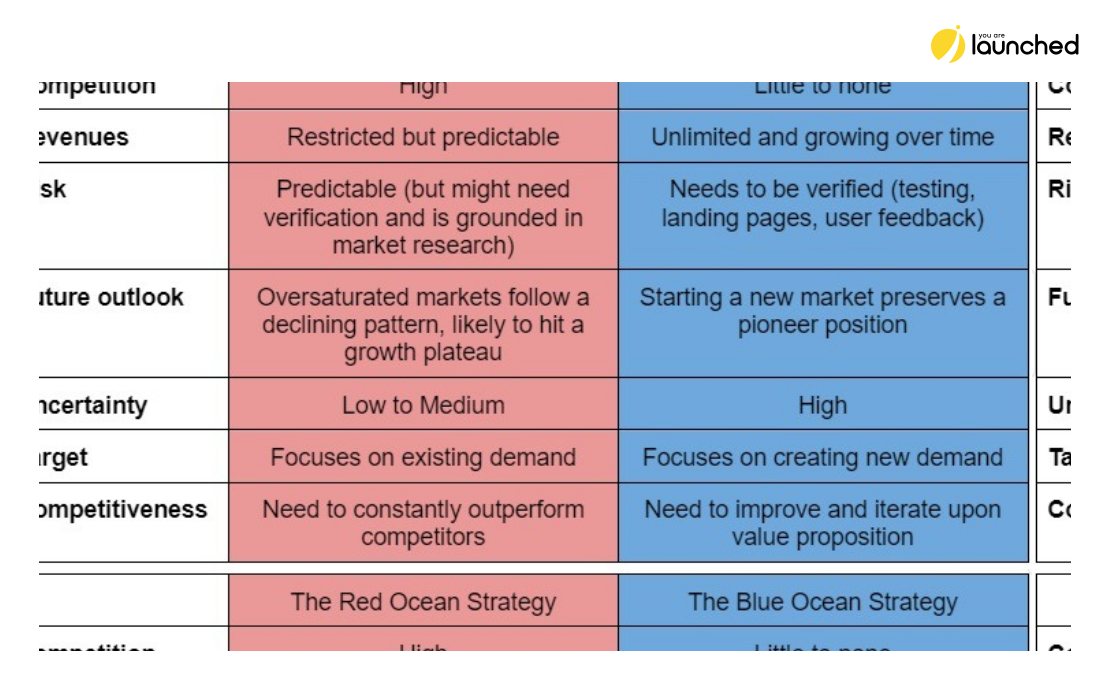
If you decide to develop an MVP, this choice is the first input to the MVP development process. Based on this, market problem validation or market demand validation will ensue. Market problem validation under the Blue Ocean strategy will determine if it is a reasonable path to take. In addition, if existence of the problem is confirmed, it is most efficient to develop simple landing pages as your MVP to ‘test-drive’ your potential blue ocean. A similar thing can be done following the Red Ocean strategy. You can start by developing a landing page to check the demand. Only after that, the business owner will invest in MVP development. Lean MVP development always offers tools to minimize risk and safeguard investment as much as possible.
You can find out more about how to safely Develop Custom MVP app. If you are still unsure whether it is time to invest in custom mVP development, check out this article.
Final Thoughts
- So, do you want to use the benefit of knowing, and follow the Red Ocean Strategy?
- Or would you choose to dive into the unknown opting for the Blue Ocean Strategy?
For many, it will be a matter of what you as a business owner are comfortable with.
For one, risk-benefit analysis can be a deciding factor. If you are someone who is thinking of the first startup or needs to find investors, the Blue Ocean strategy might seem a bit too much of a risk. Check out Startup Services for development solutions in case you need to find investors. Anyways, you might choose to create a stable digital business with moderate revenues first. Then opt for a bigger fish and aim for the Blue Ocean.
Secondly, choosing a startup strategy might be a matter of personal preference. If you feel uncomfortable with even the sound of a high degree of uncertainty or, in reverse, of fighting fiercely for what might look like slim earnings, then the choice narrows down.
At other times, choosing a startup strategy is an experience-driven decision. You might just know a certain market and have a path mapped out in your mind. Often, it happens with the businesses that have had a long-established physical presence. They’ve got a lot of first-hand data, and knowledge of competitors and consumers. So a business owner has a clear formulation of strategy in their mind.
Finally, modern development agencies can offer ways to minimize risk whatever startup strategy you choose. There are stages preceding an MVP development. In general, they are:
- validating the market need,
- validating the idea,
- the discovery phase, and
- testing the demand with the landing page as an example.
You can find the overview of the entire development process following these 5 startup stages.
FAQ: Red Ocean vs Blue Ocean Startup Strategy
The Red Ocean strategy involves competing in an existing market with known competition, aiming to outperform rivals and capture a larger market share. The Blue Ocean strategy focuses on creating a new, uncontested market space, making competition irrelevant by offering unique value.
Red Ocean strategies compete in existing markets with established rules and competitors, focusing on outperforming rivals. Blue Ocean strategies create new market spaces with unique offerings, where competition is minimal or non-existent.
Most startups choose the Red Ocean strategy because the market is known, providing easier access to market data, established customer bases, and clearer paths to profitability. It allows for faster MVP development and predictable growth.
The Blue Ocean strategy offers higher profit potential, less direct competition, and the ability to create a unique market space. It allows startups to innovate in value offerings and capture untapped demand, often leading to substantial long-term growth.
A classic example of a successful Blue Ocean strategy is Cirque du Soleil. They combined elements of circus, theatre, and entertainment to create a unique offering that appealed to new audiences, resulting in a new market space with minimal competition.
In the Red Ocean strategy, intense competition can lead to reduced profit margins as businesses cut prices and increase marketing budgets to capture market share. This can result in a growth plateau as the market becomes saturated.
In the Blue Ocean strategy, innovation focuses on value creation rather than technological advancement. It involves redefining market boundaries and offering products or services that meet unmet needs, thereby creating new demand.
Disruptive innovation involves creating new technologies or business models that displace existing markets, such as digital cameras replacing film cameras. The Blue Ocean strategy, on the other hand, focuses on creating new value offerings in uncontested market spaces without necessarily displacing existing markets.
No, the niche strategy targets specific segments within an existing market with unique value offerings, aiming to meet specific needs. The Blue Ocean strategy, however, creates entirely new markets by redefining value propositions and attracting a broader audience.
Startups should consider their risk tolerance, market knowledge, and long-term goals. The Red Ocean strategy is suitable for those seeking predictable growth in known markets, while the Blue Ocean strategy is ideal for innovators looking to create new market spaces with higher profit potential.
Key steps include validating the market need, validating the business idea, conducting a discovery phase, and testing demand with a landing page. These steps help minimize risk and ensure that the chosen strategy aligns with market opportunities and business goals.

