

Blue Ocean and Red Ocean. Comparing Startup Strategies
We have already discussed the definitions of blue ocean and red ocean startup strategies in the article “Blue Ocean and Red Ocean. Pros and Cons”. So, in this article, we’ll discuss caveats around the concepts and their practical application. We’ll uncover how to go about finding a blue ocean for your business as compared to a red ocean. We’ll compare and contrast strategic considerations as they relate to actions behind startup launch.
Let’s first quickly bring you up to speed on some definitions. The Red Ocean is a traditional business. Red represents the fierce competition where market players fight for existing demand. Even though the market is tough, there is a benefit of knowledge. For one, you can research the market and the competitors. You can back up your business plan with market data.
In contrast, the Blue Ocean is a completely new market. Blue represents the sense that it is free. There is no competition and unlimited market demand. However, innovating a value proposition like this requires work and testing the waters. Plus, you do not have much to go on in terms of business forecasting or traditional research as you explore a completely new market.
Table of contents

Red Ocean Strategy: Startup Toolkit
The red ocean means that a startup enters an existing highly competitive market. There are four main startup strategies to compete in such a market:
- Cost leadership
- Differentiation
- Niche strategy
- Incremental innovation
Cost Leadership: the Red Ocean startup strategy
In cost leadership, your startup strategy should be built around providing the best price for the customers. This often means finding low-cost suppliers or organizing production in a cost-efficient and cost-minimizing way. Walmart’s strategy is like this. Walmart’s offering is a rich variety of low-cost items.
For a startup, this strategy will require considerable initial investment. It is only after the company scales that they can negotiate better terms with suppliers. In general, the business will be more lucrative once it reaches the economies of scale.
In terms of online market space, cost leadership heavily relies on lean methodologies. Whether it is a SaaS tool like Trello or Asana, online games, or marketplaces. Thanks to lean methodology, your startup incurs the least operations expenses. Therefore, you are able to provide the lowest prices.
Red Ocean Differentiation: Apple, AI, AR, VR
Here, your key goal is to differentiate your offering with unique attributes. It must be valued by customers. So, consider customer-centric approaches, investment in branding, emphasis on quality, and customer service.
For example, Apple is a standout technology company. Its brand is widely recognizable. Its design and feature set differentiates it from competitors.
In the digital space, companies differentiate by including unique features, outstanding UIs, superior UX, or high-tech technology. For instance, Upwork works on an AI algorithm to provide the best match between a freelancer and a job. In online gaming, it is becoming all about virtual reality (VR) to create an immersive user experience. In marketplaces, it can be either AI technology or Augmented Reality.
Niche Strategy in the Red Ocean
No matter how competitive the market is, there is always a niche of unmet customer needs. In this strategy, there is a lot of personalization and tailoring the offering to specific customer needs.
For this strategy, customer research and user personas are a must. While these tools are valuable in any startup, niche strategy cannot function without them.
Businesses that utilize this strategy are:
- Rolls-Royce with its focus on luxury clientele;
- Bee’s Wrap with its focus on eco-friendly, cruelty-free, and vegan products;
- Patricia’s Couture which makes clothes for pet owners with their pet’s face in design.
In the digital space, numerous businesses utilize this strategy:
- SaaS services for particular specialists, like law professionals or nurses.
- Games for fans of particular fantasy series or other exclusive RPGs.
- Marketplaces that provide selections for a specific demographic or a particular product category.
By the way, this strategy can be sometimes mixed up with the blue ocean strategy. It is due to the fact that the offering is quite unique.
Incremental Innovation in the Red Ocean
This strategy puts emphasis on R&D – research and development. Your business always needs to research so that you can find newer improvements. Your startup should start with an offering that is a little more innovative than what is in the market. And then, you continuously add innovative elements in small increments. The goal is to keep your offering above the market. Virtually every smartphone company uses this strategy.
In the digital space, companies also widely practice incremental innovation. For one, many cloud companies continuously innovate in security aspects. In the gaming industry, the following incremental innovation techniques are popular:
- updating game content,
- introducing new features, and
- innovating game scenarios.
In the marketplace space, companies can be innovative with:
- algorithms,
- pushing performance limits, or
- adding more payment options and ways.
Wrapping up Red Ocean Startup Strategies
These four main red ocean startup strategies are very different. However, they have one thing in common. They are always benchmarked against the competition. Your startup either needs to:
- offer lower prices than competitors,
- or be considerably different from competitors,
- squeeze into a niche between competitors,
- or incrementally innovate to stay above competitors.
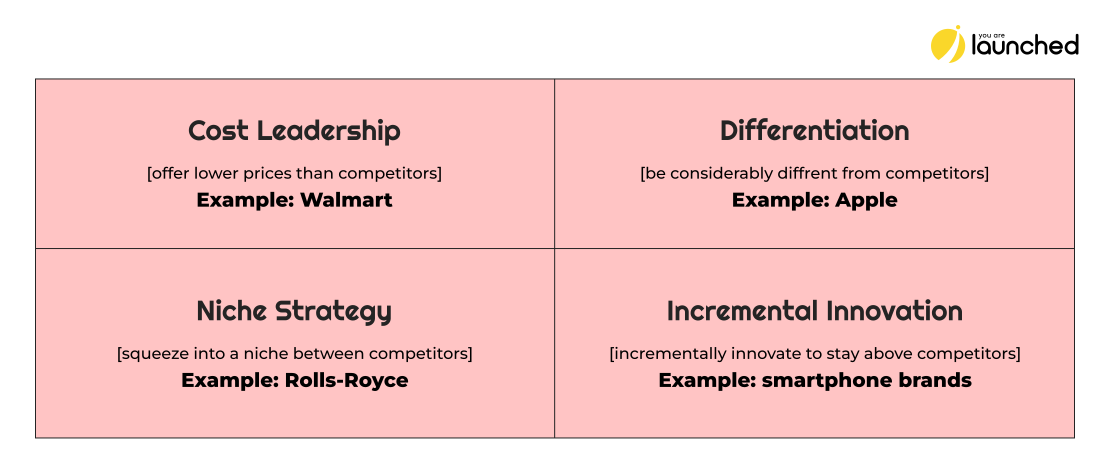
So we arrive at the key differentiation point from the Blue Ocean strategy – competition. In the Blue Ocean market, your task is to make competition irrelevant to your business rather than try to outperform it in some areas.
Besides the point, you can also dive deep into strategy development and read our article How to Develop a Digital Product Strategy for a Startup?

Blue Ocean: A Path to Discovery
To discover or create the blue ocean, the authors of the concept – Chan Kim and Reneé Mauborgne – came up with the 4 Actions Framework or ERRC grid. ERRC stands for Eliminate, Reduce, Raise, and Create. It is not enough to simply reduce the price or costs and create one new feature. You need to also eliminate an element from the traditional product offering that customer do not value. Plus, there should be at least one element that your offering does substantially better. We’ll discuss the framework based on the example of [Yellow Tail].
Yellow Tail is a small family-owned winery that started with an ambition to enter the US market. They wanted to deliver a product that was nothing like a traditional wine market had seen before.
- In 2000, they launched with a plan to sell 25 thousand wine cases. They actually sold 1 million cases that year. This is the beauty and the uncertainty of the Blue Ocean approach. The beauty is that success can be unimaginable. The uncertainty is that you cannot plan it.
- The year they launched their wine offering was: one white and one red wine. Currently, the offering on the US market boasts 8 red wine varieties and 6 white wine varieties. This is the most attractive side of the Blue Ocean strategy: the growth is almost unlimited.
4 Actions Framework For Blue Ocean Startup Strategy
The framework for creating a new value proposition is in the picture below. From it, you can see that this framework is rooted in 4 key questions. To put it in simple terms:
- Remove at least one crucial barrier/standard all players adhere to;
- Offer something cheaper than the market average;
- Offer something better than anyone in the industry;
- Add one factor that has never been offered.
It sounds complicated when it is abstract like that. Let’s illustrate this process with an example.

Source: Kim, W. Chan and Mauborgne, Reneé, Blue Ocean Strategy, How to Create Uncontested Market Space and Make the Competition Irrelevant, Expanded Edition, (Boston: Harvard Business Review Press, 2015).

Yellow Tail: Classic Blue Ocean Strategy Example
Blue Ocean Action 1: Eliminate
What value element is expensive to maintain that does not add to your value curve? What things create redundant complexity in business?
Yellow Tail saw an opportunity to eliminate:
- Enological terminology in wine,
- the year and storage techniques.
Surely, they are important factors for wine connoisseurs. 75% of adults drink wine in the US, but how many of them are actually wine connoisseurs? By generous estimate, true wine connoisseurs are somewhere between 4.5% to 6.7% percent of that audience.
So, for a casual drinker, these qualities do not add much value.
Blue Ocean Action 2: Reduce
What value elements are overly exaggerated in the industry that do not contribute much to the core value? Customer preferences always change. In addition, customer preferences get reshaped by the market landscape as well. So, think about value elements that no longer create much value in the eyes of customers.
For Yellow Tail, they are the following wine value elements:
– vineyard the wine is produced in, its region,
– the weather and soil conditions that impacted its taste,
– and wine range.
In addition, if you think about wine startups, it is expensive to produce a variety of wines. However, consumer research has found a caveat. The research asked the opinions of consumers who consume alcoholic drinks, beers, and other spirits. For them, wine variety is seen as discouraging and pretentious. Therefore, it was a reasonable choice to reduce these elements in the value curve.
In fact, they presented only two wine choices upon their launch. For the US consumer, they were Chardonnay for white and Shiraz for red.
Blue Ocean Action 3: Raise
What factor in the value offering should be improved? What is this one thing that consumers always want to be significantly better than the market is currently offering?
In order to escape the budget versus premium wine competition, Yellow Tail chose an interesting price move. The company raised the price above the budget wines but kept it below the premium ones. What it did was create an enhanced value perception for the consumer. Those who looked for something that is better value and quality were now offered an option.
In addition, Yellow Tail increased its in-store engagement with the consumer. It included better shelf position, more prominent displays, and more effective promotional campaigns. For instance, the Super Bowl promotional display.
So, marketing and positioning were the factors that Yellow Tail did much better than the competition.
Blue Ocean Action 4: Create
Consider adding something that the industry hasn’t offered yet. What wine industry has never provided to its customers? Generally, consumers of alcoholic drinks and spirits view drinking as a fun activity. However, it is rarely viewed like that when it comes to wine.
Yellow Tail sensed the opportunity to associate drinking wine with fun and adventure. For this, they adopted a playful and adventurous brand identity. In addition, wine shop sellers wore Australian outback clothing provided by Yellow Tail. They turned store sellers into brand ambassadors.
The other factor is the ease of drinking. If you consider consumer who have experienced palette and appreciate wine for its enological qualities, they’d prefer drier wines with complex palette. However, when it comes to a generic consumer, they would love sweeter, fruitier, and lighter palettes. Indeed, critics negatively regarded Yellow Tail’s sweet fruity wine flavor. However, consumers loved it. It was much easier and enjoyable to drink.

Final Thoughts on Red Ocean VS Blue Ocean for Your Startup
So, you decide to Develop Custom MVP app. Before applying either the red ocean or blue ocean startup strategies, a startup still has to go through at least two important stages:
- Identifying consumers’ needs and pain points,
- Market research to map out the competitive landscape.
After that, it is time to consider the red ocean or blue ocean approach. In The Blue Ocean strategy, let’s look at what it may look like for a digital business. Here is a template:
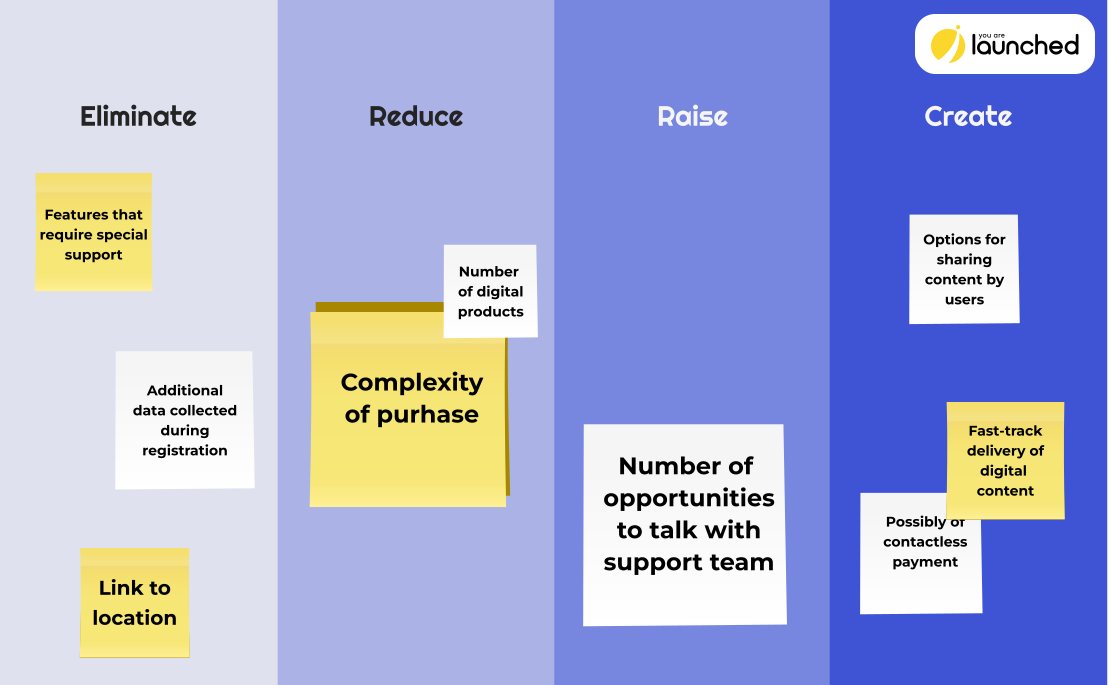
Then, regardless of the chosen framework, you’ll need the prototype, a landing page, or an MVP to test your value proposition. After that, the continuous process of iterate-and-improve follows.
FAQ: Blue Ocean and Red Ocean. Comparing Startup Strategies
A Red Ocean strategy involves competing in an existing market with established competition. Businesses in this strategy fight for market share by differentiating themselves through cost leadership, unique features, niche markets, or incremental innovation.
Startups in a Red Ocean market can employ the following strategies:
• Cost Leadership: Offering the best price by minimizing costs.
• Differentiation: Providing unique features or superior quality.
• Niche Strategy: Catering to specific, unmet needs of a customer segment.
• Incremental Innovation: Continuously improving products or services to stay ahead.
A Blue Ocean strategy involves creating a new market space, making the competition irrelevant. This strategy focuses on innovation and creating a unique value proposition that hasn’t been seen before.
The 4 Actions Framework helps businesses create a unique value proposition by answering four key questions:
• Eliminate: What factors can be eliminated that the industry takes for granted?
• Reduce: What factors should be reduced well below the industry’s standard?
• Raise: What factors should be raised well above the industry’s standard?
• Create: What factors should be created that the industry has never offered?
Yes, Yellow Tail, a small winery, successfully employed a Blue Ocean strategy by:
• Eliminating complex enological terms.
• Reducing the variety of wines offered.
• Raising the price point above budget wines but below premium ones.
• Creating a fun, adventurous brand identity and an easy-to-drink wine.
The advantages of a Red Ocean strategy include:
• Market Knowledge: Established market data and competitor analysis.
• Customer Familiarity: Existing demand and customer base.
• Predictability: More predictable business planning and forecasting.
The risks of a Blue Ocean strategy include:
• Uncertainty: Lack of market data and unpredictable outcomes.
• High Investment: Initial costs for innovation and market creation.
• Market Acceptance: Difficulty in predicting customer acceptance and demand.
A startup should consider:
• Consumer Needs: Identifying unmet needs and pain points.
• Market Research: Understanding the competitive landscape.
• Resource Availability: Assessing available resources for innovation.
• Risk Appetite: Evaluating the willingness to take on the uncertainty of a new market.
Market research is crucial as it:
• Identifies Opportunities: Helps in finding gaps and unmet needs.
• Informs Strategy: Provides insights into competitor strengths and weaknesses.
• Reduces Risk: Minimizes the uncertainty associated with launching a new product or service.
Customer feedback is vital as it:
• Guides Improvement: Informs continuous product or service enhancements.
• Validates Value: Confirms the value proposition and market fit.
• Drives Innovation: Sparks ideas for new features or offerings.

