

Top 10 Startup Business Models & Revenue Models to consider
Startup business model and revenue model are two terms that are often used synonymously. Yet, there is a distinction. The startup business model explains organizational processes related to creating, delivering, and capturing value. The revenue model specifically focuses on how a startup will generate income. In this blog post, we will discuss the top 10 startup business models and revenue models that make sense in today’s competitive environment.
Table of contents
- Subscription-based startup
- Pay-as-you-go startup business model
- Ad-based startup business model
- Transactional-based startup
- Direct-to-consumer (DTC) startup business model
- Marketplace-based startup
- Razor and blade startup business model
- Private-label startup
- Franchise Startup Business Model
- Dropshipping Startup
- FAQ: Top 10 Startup Business Models
Subscription-based startup
This startup business model has been growing considerably, doubling from year to year. In addition, many businesses realign their business models to match the subscription model. Why is this model so desired?
Recurring revenue streams
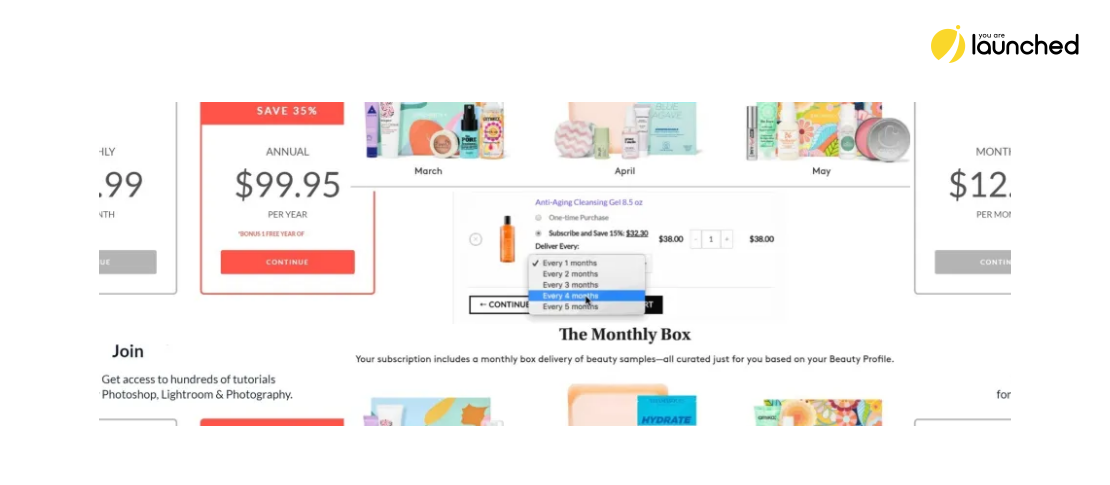
Reason #1 is recurring revenue streams. A variety of subscriptions have been appearing ubiquitously across all businesses. You can find affordable 1 to 10$ monthly subscriptions. Also, there are more substantial $29-$49-$99 tiered subscriptions. Some subscriptions are offered monthly. Other companies add annual ones too.
Customer Loyalty
Apart from generating a predictable revenue stream, this revenue model ties your customers to your business. It leads to customer loyalty and reduces churn. After all, why order somewhere else, if you have discounts or free delivery with a particular company? Or for example, if you need something, would you check first a place where you are a premium user?
Automaticity of transactions
Lastly, subscriptions no matter how small or big are often automated payments. It removes the need to convince a customer to make a purchase every transaction.
Revenue and startup business model for subscription startup
So, to adopt a subscription revenue model, a startup needs to ensure a fitting business model. It should be able to align its operations with continually delivering value for which customers will be paying on a regular basis.
Delivering value on a regular basis can be achieved in two ways:
- It can be either a regular production process of something new for subscribers. It can be content, updates, etc.
- Or on the cost side, a startup business model needs to be built in a way that subscription users can be offered lower prices or discounts.
At the same time, your non-subscription offering should still be attractive to new users. Some businesses though choose to go a different direction. They make non-subscription prices so high and contrast it with excitingly big discounts for subscribers. It narrows down a choice to subscription-only.
Subscription model for startups
Why is this model so central to startups? Starting a new business is often unpredictable financially and your business needs a lot of feedback to capture the market. To hit these two birds with one stone – a subscription-based model is the best solution.
- You always have a revenue stream to rely on. If you need to obtain additional funding, you can show some subscription streams to back it.
- And who better to give you feedback than your subscribers?
Overall, there is even a term coined – a subscription economy. The subscription economy hit $72.9 billion mark in 2022 and is forecasted to reach $1.5 trillion already in 2025.

Some of the famous companies using a subscription model include:
- Netflix,
- Amazon Prime,
- Apple One,
- ButcherBox,
- ClassPass, and others.
Pay-as-you-go startup business model
In this model, you bill your customers based on their usage. It invites the relationships of transparency. In addition, it lowers barriers to entry as a customer does not need to commit like in a subscription model.
The pay-as-you-go revenue model allows the business to align its cost-per-use. For example, on Netflix, which follows a subscription model, there are wide discrepancies in usage. One customer would watch a movie or an episode a day. Yet, another customer on the same subscription plan will bingewatch for weeks. It makes it extremely difficult to forecast costs.
In this scenario, Netflix will incur different data transfer costs, server usage, and payments regarding licenses for different content. For startups, it might be difficult to cater to such cost variability.
In contrast, YouTube Movies uses a pay-as-you-go model. The prices vary depending on the title of the chosen movie, its resolution, and its release date. In addition, a customer can choose a rental or a purchase.
When a business can link usage per customer to revenues, it makes it easy to manage value propositions and assess profitability. Importantly, YouTube Movies manages to combine both: premium subscriptions and pay-as-you-go. It gives its users choice and flexibility.
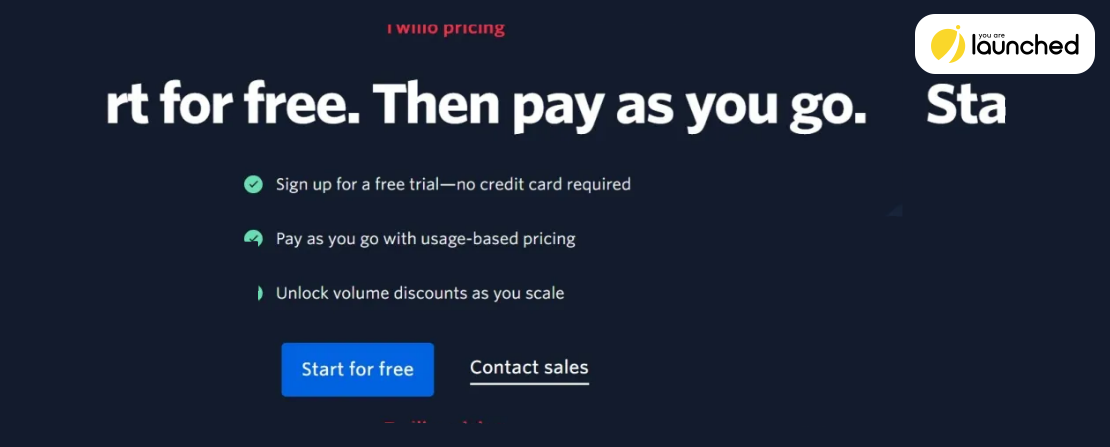
So, the companies successfully implementing the pay-as-you-go model are:
- YouTube Movies,
- Amazon Web Services,
- Twilio

Ad-based startup business model
First, think of social media apps, messengers, or YouTube. These businesses create services for which customers will not be willing to pay. But, they can aggregate large numbers of users and make money by showing ads.
Ad startup business model focuses on providing a service to maximize its reach. It can be social media, news, gossip websites, social media, a learning platform with flashcards, or learning games. Then, you focus on reaching out to potential advertisers.
By providing free service, you also should focus on analytics. Potential advertisers would like to reach their target audience. So this revenue model requires a few essential considerations.
In terms of advertising itself, there are a few options that can be combined. It can be:
- an ad display,
- pay-per-click ads, or
- sponsored content.
In short, your resource is your audience which you engage with free content or service.
Successful ad businesses are:
- Snapchat
- Medium
- Mobile app games
- utility apps and more
Startup Services can be used to custom-build an app for your ad-based startup.
Transactional-based startup
This model is likely to be the oldest and most widely implemented. It can be found throughout traditional offline businesses and online. Generally speaking, this model has always made money. This is a common revenue model of any retail store – the revenue is received from a single purchase – transaction.
In an online space, this model is the foundation of any e-shop, e-commerce, or payment processing application. The more users you get who make transactions, the more your business makes.
The startup business model in this case should be concerned with two main points:
- The number of transactions;
- The markup on transactions.
Based on this, the business model can go either into a low-markup high-volume model or a high-markup low-volume one. Mainly, MVP development will aimed at achieving the right balance between the markup and volume.
Examples of transactional businesses are ;
- Walmart,
- Uber,
- Airbnb,
- Apple App Store, and
- PayPal.
Direct-to-consumer (DTC) startup business model
This model involves your own product or service as well as your brand. For instance, in electronics section in Amazon or Walmart, you can get an Asus laptop. Also, you can go to the Asus website and buy it directly from them. The latter is the DTC model.
When you are a startup, and you want to have control over customer experience and profit margins as well as brand development, this is a model for you.
Many product startups choose to develop their own brand and engage in a direct-to-consumer model. This is not the easiest to launch but it can be the most sustainable over time. With this model, you oversee the relationship-building process between customers and your business. Also, you have the opportunity for personalization.
This model emphasizes such metrics as
- customer engagement,
- customer experience, and
- customer lifetime value among others.
Recently, many brands have shifted towards this model. Yet, it does not prevent you from selling your inventory through other parties as well. Having a direct relationship with your customers and loyal customer base is a basis for product innovation as well.
Examples of DTC businesses include:
- Dropbox,
- The farmer’s dog,
- GoodRx,
- GoPuff, and others
Marketplace-based startup
The marketplace business model can be viewed as a special and extended case of the transactional model. In the transactional model discussed above, the business usually owns the merchandise. However, in the marketplace startup business model, the marketplace owner only provides a place for buyers and sellers to meet and engage without merchandise ownership. In addition, revenue-wise, this model can have varied ways to generate income.
- To start, a marketplace owner can either set a commission per transaction or a flat fee regardless of the amount of the transaction.
- Depending on the number of sellers, you can introduce promotional extras. It means a fee for a sponsored listing that is highly visible to the customers.
- You can also introduce advertising of the seller’s goods on your marketplace for extra fees. Additionally, you can offer extra features for extra prices. For instance, you can have some analytics which users unlock for a fee. Or such services as delivery or others.
This model successfully operates in companies like:
- Etsy,
- eBay,
- Fiverr, and
- Upwork.
To get started with this startup business model, visit Startup Services. You can also read our article How to develop a custom marketplace app like Walmart?

Razor and blade startup business model
The name of the model originates in men’s care products. Razor is a cheap item. However, it needs constant refills of the blades. This is where the revenue comes from. Other complementary items also would come with a high markup.
The other name of this model is ‘bait and hook’. Basically, the startup business model revolves around designing a product that customers can buy cheaply. Then, it should also require complementary products that will be lucrative for business. With this business model, the focus is on maximizing customer lifetime value and driving recurring purchases. The revenue model should strive to minimize the price of the razor or bait. Then, you focus on high-margin add-ons and consumables.
The examples are:
- Gilette,
- gaming consoles like Xbox or PlayStation,
- single-serve coffee makers,
- printers,
- Amazon Kindle, and so on.
Private-label startup
The idea of a private-label business is to manufacture a product at a third-party manufacturing site. Often, many companies manufacture at one plant but ask for some design differences. Then, it is branded and sold as a labeled or branded item.
There are two main kinds of this business model.
- One aims to undercut market prices.
- The other one aims for the premium segment.
For instance, if you think about national retail stores, they often use their private label to undercut prices. This is done to offer more affordable prices and gain the loyalty of a price-conscious consumer base. The revenue model in this case relies these factors to generate profit:.
- One is a direct close relationship with a manufacturer to negotiate lower costs.
- The other one is to remove an intermediary so it is a manufacturer-retail direct link.
- Aso, the business cuts on R&D costs.
The premium private label often has a tighter involvement in the production process. They might suggest special sourcing of ingredients or particular storing procedures. So, there are some investments in R&D. Also, the business does a lot more research to position its product.
In digital space, it is often utilized in learning content, VPN services, and other services. For instance, a lot of AI providers utilize widely available white-label models such as GPT, Gemini, or Claude. Then, a company would utilize one or several of those to create its own private-label AI service.
Companies that utilize this model are:
- Great Value by Walmart,
- Up and Up from Target,
- Insignia,
- Jasper AI,
- Grove Co.

Franchise Startup Business Model
The franchise business model involves a franchisor who provides with a business that has a proven track record of success. As a startup, it is the safest option because:
- First, you get a working business model.
- Second, you are operating under a well-known brand.
- Third, the franchisor maintains the profitability of the model on an ongoing basis and updates all relevant elements.
For instance, one valuable element is marketing materials are provided and updated on a regular basis.
However, you often pay an upfront sum of money for the franchise fee. Then, there are also monthly royalties from sales.
The franchise model operates successfully in all sectors: fitness, education, hardware stores and other retail, and so on. Some famous franchise businesses are:
- McDonald’s,
- 7-Eleven,
- KFC, and
- Pizza Hut.
Dropshipping Startup
This business model entails having an online store that markets products, gets orders, and then redirects those to a third party. It can be a wholesaler, a manufacturer, or a retailer. Then a third party manages the physical inventory. So, you don’t need to worry about storing inventory, restocking, shipping, and other complexities. Your startup focuses on:
- maintaining an online store,
- handling relationships with customers, and
- collecting orders.
The revenue comes from the margin between what you sell items for and a wholesaler’s price for you.
This business model requires little upfront investment since you do not need to pay for any goods. Your expenses reside in developing an online store, its maintenance, marketing, and employees. This model is scalable as once your store grows you can add more third parties to provide merchandise for marketing.
FAQ: Top 10 Startup Business Models
The startup business model explains the organizational processes related to creating, delivering, and capturing value. In contrast, the revenue model specifically focuses on how a startup will generate income.
A subscription-based startup business model involves offering products or services to customers on a recurring basis, typically monthly or annually. This model generates predictable revenue streams, enhances customer loyalty, and automates transactions.
The subscription model provides a steady revenue stream, helps in obtaining feedback from subscribers, and is financially predictable. It also supports the concept of a “subscription economy,” which is rapidly growing and expected to reach $1.5 trillion by 2025.
In the pay-as-you-go model, customers are billed based on their usage of the product or service. This model offers transparency, lowers entry barriers, and aligns cost-per-use, making it easy to manage value propositions and assess profitability.
The ad-based startup model generates revenue by displaying advertisements to users. Businesses provide free services to attract a large user base and then monetize through ad displays, pay-per-click ads, or sponsored content. Examples include social media platforms and mobile app games.
The transactional model generates revenue from single purchases or transactions. This model is common in retail stores, e-commerce, and payment processing applications. Success depends on the number of transactions and the markup on each transaction.
The DTC model involves selling products or services directly to consumers, bypassing third-party retailers. This model allows startups to control customer experience, profit margins, and brand development. Examples include Dropbox and The Farmer’s Dog.
The marketplace model provides a platform for buyers and sellers to engage without owning the merchandise. Revenue can be generated through transaction commissions, flat fees, sponsored listings, advertising, and additional services. Examples include Etsy, eBay, and Fiverr.
The razor and blade model involves selling a primary product at a low cost and generating revenue from high-margin complementary products. Examples include Gillette razors and blades, gaming consoles with games, and printers with ink cartridges.
In the private-label model, a product is manufactured by a third party and sold under a startup’s brand. This model can target either price-conscious consumers by undercutting market prices or premium segments with higher quality and exclusivity. Examples include Great Value by Walmart and Jasper AI.
The franchise model involves operating a business under an established brand with a proven track record. Franchisees benefit from a working business model, brand recognition, ongoing support, and marketing materials. Examples include McDonald’s and 7-Eleven.
Dropshipping involves running an online store that markets products and processes orders while a third party handles inventory, shipping, and logistics. This model requires minimal upfront investment and focuses on online store maintenance, customer relationships, and order management.

