

How to overdrive the risks in startup outsourcing?
IT outsourcing is an extremely complex, layered, and thriving industry. Today, virtually every kind of business chooses to outsource different aspects of their business. Big established corporations mainly choose to do that to form, enhance, and maintain their competitive advantage. Smaller companies and startups outsource to utilize expertise for a fraction of the in-house team cost and faster time-to-market. However, benefits come with risks in outsourcing. Naturally, risks in startup outsourcing will be different from those applicable to big corporations. In this article, we’ll focus on risks in startup outsourcing specifically and strategies to actively mitigate them.
Table of contents
- Brief on IT Outsourcing
- Risk 1: Lack of Control in Startup Outsourcing
- Risk 2: Communication
- Number 3: “Missing” the Deadlines as a Major Risk in Startup Outsourcing
- Startup Outsourcing Risk 4: Poor Quality
- Risk 5: Unforeseen Fees of Startup Outsourcing
- Startup Outsourcing Risk 6: Unmet Expectations
- Risk 7: Unintentional Disclosure in Startup Outsourcing
- Startup Outsourcing Risk 8: Losing Expertise Autonomy
- Risk 9: Lacking Relevant Market Experience
- Risk 10: Staff Turnover in Outsourcing
- Overdriving the risks in startup outsourcing: FAQ
Brief on IT Outsourcing
Global IT Outsourcing market is huge and growing steadily from year to year. The figure below shows that revenues had a slight drop from 324 billion dollars to 320 in 2020. Then in 2021, it recovered to 360 billion and kept on growing. Future estimates since 2024 look bright going up to almost 800 billion in 2028.

The IT outsourcing market comprises several distinct professional services. By doing that, companies keep their focus on their key functions and also cut costs. Moreover, for big corporations, outsourcing is a way to protect their business and make it more resilient. Below, you can see the structural make-up of professional services within the global IT outsourcing industry.
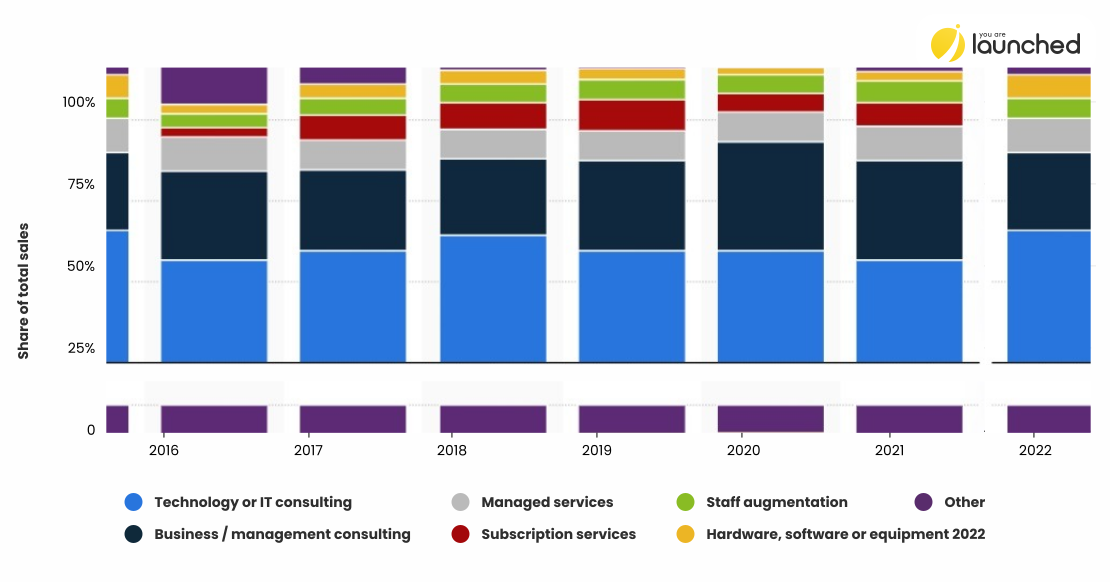
Deloitte’s executive report on global outsourcing survey shows quite a few quality changes happening in the industry. Their 2020 report indicates that the primary goal for outsourcing was to cut costs. If you remember from before, it was the year of COVID-19 and a slight drop in the economy overall.

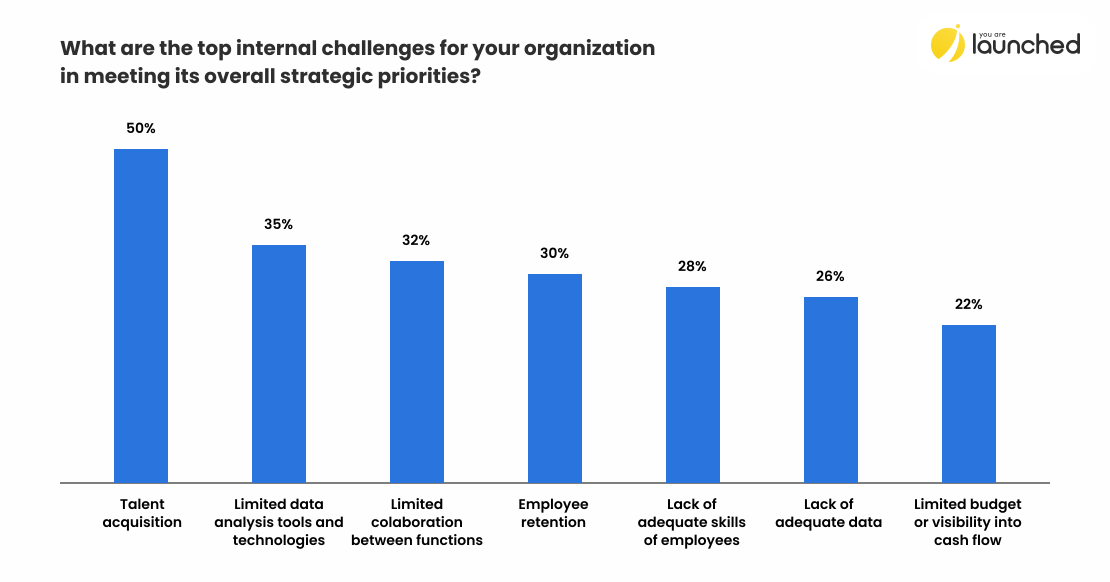
2022’s report paints quite a different picture. Now, outsourcing plays a role in solving a company’s internal struggles as well as introducing value-adding processes. The figure below shows that the top reasons to outsource are:
- Get access to a larger talent pool;
- Utilize the newest technologies and data analytics tools;
- Improve collaboration between different company’s departments;
- Increase employee retention;
- And, finally, acquire professionals with adequate skill sets.
Big corporations not only seek to outsource some IT functions. They are also building an outsourcing ecosystem to thrive in the current competitive environment.
IT Outsourcing for Startups
When it comes, to startups, their objectives are the following:
- Lower cost compared to hiring in-house developers
- Flexibility in getting the right mix of professionals as requirements evolve;
- Faster speed to market as you get to utilize vendor’s different professionals, expertise in development and market knowledge.
Let’s now talk about how to obtain all of these benefits without running the top 10 risks in startup outsourcing.
Why Outsource for a Startup?
Let’s imagine a simple scenario. You are the CEO of a small company with just a product manager and a marketing specialist on your team. For example, it is a local fitness company. You already have offline expertise in this area. Plus, you already manage several trainers and a few dozen clients. Lastly, you see it is in demand and you want to go bigger.
So, you have a business idea to develop a marketplace app that connects local fitness trainers and consumers for personal training sessions. You need to create this platform for which you need to hire developers. But what kind of developers? How exactly should the platform look? How many people would you need for that? And when hiring people, it is so much tax and legal work. So you decide to outsource this part to a development agency.
These are actually the main reasons for early startup outsourcing. With an in-house team, it is hard to:
- define the scope of work,
- determine the level and expertise of engineers for the project,
- and in-house hiring would be too expensive and inflexible.
So, getting in touch with a development agency solves all these issues.
Of course, outsourcing is popular with companies looking to get into a new market. The company’s departments might have the needs to outsource some of their tech-heavy operations.

Risk 1: Lack of Control in Startup Outsourcing
In your offline business, you know every aspect of the operations. You are in touch with clients and your team. You are involved in every big and small decision. However, when outsourcing a big chunk of work like an MVP app development, you will not have that level of involvement.
This is one of the most common risks in startup outsourcing. To be proactive in minimizing the negative impact of it on your startup, you can do the following:
- Define the key areas where you need cooperation between your team and development agency. Make sure the development agency is aware of these and is willing to cooperate. Depending on your level of trust, you can have a verbal agreement. Alternatively, write it down in service-level agreement (SLA).
- A sure sign that your vendor is cooperative is in the meeting schedule and versatile communication channels. From your side, it is best to appoint one person to streamline the conversation.
Risk 2: Communication
As you saw the key to minimizing the previous risk is communication. However, communication is yet another one of the risks in startup outsourcing. For instance, communication risk stems from:
- Time difference might make it difficult to get speedy replies and timely updates;
- Language barriers might lead to misunderstandings;
- Cultural differences might lead to information loss or misrepresentation.
The best approach to taking control of this risk is to be watchful from the get-go. The first project phase is the discovery. It is often short and little development is done apart from prototypes. At this stage, be sure to observe how the development agency handles communication.
- Are they detailed enough?
- Are they reactive to feedback from your side?
- Do they deliver on their promises?
- Are they willing to accommodate your requests?
- Do they try to address your concerns?

Number 3: “Missing” the Deadlines as a Major Risk in Startup Outsourcing
It’s rare that development agencies miss the deadlines. But what they can do is to miss the deadlines for particular deliverables. They might run into trouble with one sort of task and deliver something else instead. They are still moving the needle with the project. And, overall, it is not that bad. In fact, it is not bad at all. It becomes damaging when you as a business have other business processes tied to particular deliverables. And you don’t get informed.
For example, you synchronizing offline marketing campaigns with advancements in the digital side of things. And key features tied to marketing get delayed. So all leads coming via QR code were greeted with a 404 error. This sort of thing happens due to misconception. In agile development, it is considered a strong point that tasks can be done flexibly. Therefore, the plan of deliverables is often about ‘expected’ dates, and not ‘guaranteed’. Percent-wise, you will get progress as scheduled. But it might deviate from the exact details. To secure yourself from this risk, inform the development agency that you plan your own activities for that particular deliverable. Make sure that to get a guarantee on the delivery date. In addition, every such deliverable is often formulated by a technical product owner. And each such deliverable must pass acceptance criteria. Not sure what these are? Check Acceptance criteria examples.
Startup Outsourcing Risk 4: Poor Quality
There are tons of outsourcing options out there. In general, it is better to choose those whose credibility you can check. For instance, one such way is to check the company on Clutch. Trusting verified vendors is a good way to go to mitigate this risk.
If you opt for a less established company you run the risk of low quality. Why is this an issue? Because in reality, a business owner is not a tech expert. It will be hard for them to verify the tech stack or developers’ expertise. Even such a thing as the vendor’s website… will not say much to a non-tech person.
Unfortunately, if you opt for a newer player on the market and get a really good offer, it might be a risky business. The only piece of advice is to set yourself a money limit when you absolutely must see a working product. And be prepared to cut your losses.

Risk 5: Unforeseen Fees of Startup Outsourcing
Not every vendor is upfront about possible extra charges. Usually, some vendors try to put off these talks until extra charges occur. In an attempt to sign up a client, some vendors choose to be not fully transparent. These extras might be for emergency bug fixing, requirement changes, unanticipated updates, after-hours assistance, and whatnot.
As with most of the risks in startup outsourcing, mitigating this risk relies on two major factors:
- Ask directly about this during the first meeting;
- Make sure things are written down in the service-level agreement (SLA).
Startup Outsourcing Risk 6: Unmet Expectations
Along with the development work, vendors might make promises regarding different business aspects. For instance, they might promise:
– unbelievably high revenue levels,
– unrealistically fast market launch,
– high security of the first product,
– round-the-clock support and whatnot.
First of all, revenue levels and launch dates cannot be set until research and first market feedback. Others like security and 24/7 support might be a trick to run up costs as extra services.
The best way to guard against giving you false expectations is to ask for assurances on the spot. If the vendor starts promising certain revenue levels, just ask to put it into SLA. If a promise of high product security, ask whether the vendor included it in the project estimate costs. And so on.
Just make sure if the vendor is promising something, there is a way of guaranteeing it in a written agreement. This way you can avoid many risks in startup outsourcing.

Risk 7: Unintentional Disclosure in Startup Outsourcing
It might happen that in the vendor’s work, they need to involve other third parties and share sensitive business information with them. Your vendor might subcontract some of the development or related functions to third parties. In this process, those other parties might need insight into the vendor’s operations and by extension your business data.
To prevent this from happening in addition to carefully drawing up an SLA, you should also make your vendor sign an NDA agreement. Moreover, ask your vendor what ways and methods are used to protect your business data. Such as asking if your project will require any disclosure with third parties on the vendor’s side.
Startup Outsourcing Risk 8: Losing Expertise Autonomy
If this is your first digital startup, it might be especially important for you. As an offline business owner, you oversee all your offline operations with your team. You might know all the ins and outs of it. If your employee for some reason was no longer with you, you have people to replace their functions. Maybe even you know how to do some tasks of that person. And if you notice anything you have a question about, it is easy to get an answer. By outsourcing what is going to be the bigger part of your business, you lose expert touch with it.
The best thing you can do about this is to make sure the representative of your firm is always involved. Not in the development, but in key aspects like deliverables plans, schedules and features setting, regulatory compliance, user experience design or other strategic moves.
In addition, if your business is highly technological and you worry about being out of touch with expert work – look into staff augmentation. You still get services from the vendor, but what this vendor does is provide their employees for your company. So all employees’ documents, taxation, and employment agreements are with the vendor. But technically these developers work for you under a staff augmentation agreement.

Risk 9: Lacking Relevant Market Experience
Let’s imagine you’ve found a great vendor, but their expertise lies in the finance and medical fields. So this vendor mostly has done projects for financial startups and medical institutions. You come up with a business idea in the fitness industry. Even though, this area seems less challenging, your vendor still lacks market knowledge. As a result, it might slow down processes related to requirement analysis and keeping to industry standards. To protect yourself from this startup outsourcing risk, check the vendor’s portfolio and case studies to identify if they’ve completed projects in your industry.
Risk 10: Staff Turnover in Outsourcing
Vendor’s staffing methods and internal circumstances might lead to high employee turnover. So developers or other project staff change frequently. Each new person will require time to bring oneself up to speed. If this happens often, it will considerably slow down project progress. In addition, if people are kicked around so often, they get less professionally involved and interested in the project. It results in a lesser quality of their contribution.
To avoid this risk, the easiest solution is to hire a dedicated team. This way you get to know all team members and they work only on your project.
The other option is to request to be informed of any staff project changes. This way you can control the situation and express concern if you believe you are getting low quality of work.
Overdriving the risks in startup outsourcing: FAQ
When startups outsource, they can run into issues like not having enough control over the work, struggling to communicate effectively, missing deadlines, receiving low-quality work, facing unexpected costs, and not getting what they expected from the partnership.
To tackle this, startups should clearly lay out what they need from their outsourcing partners and keep the lines of communication wide open. Having a designated person to handle communication can help keep things on track.
Startups can overcome communication hurdles by paying close attention to how their outsourcing partners handle communication early on and making sure everyone knows how to reach each other. Having one main point of contact can help avoid confusion.
To avoid this, startups should make sure deadlines are clearly spelled out in their agreements and that there’s a plan in place for what happens if things fall behind. It’s all about setting expectations from the start.
Startups can protect themselves by choosing reputable partners with a track record of delivering top-notch work. Checking out reviews and portfolios can help separate the good from the not-so-good.
Startups should ask lots of questions upfront about what’s included in the price and what might cost extra down the line. Getting everything in writing can help avoid surprises later on.
It’s important for startups to have realistic expectations and to make sure everyone’s on the same page about what’s possible. Clear communication and setting goals together can go a long way.
Startups should have their outsourcing partners sign agreements promising to keep their information safe and should ask about security measures upfront. Trust is key here.
Even though they’re outsourcing, startups should still stay in the loop and make sure they’re part of important decisions. Having someone on their team dedicated to overseeing the project can help keep things running smoothly.
Startups should look for partners who have experience working in their industry and who understand their specific needs. Checking out past projects can give them a good idea of what to expect.
Startups should make sure they’re kept in the loop about any changes to the team and should speak up if they’re not happy with the work they’re seeing. Building a good relationship with their partners can help smooth over any bumps in the road.

