

How to Build a Mobile IoT App: The Guide You’re Looking For
IoT mobile app development is, first of all, one of the hottest trends in mobile app development. While AI is a disruptive technology alike IoT, AI does not have such a level of acceptance and presence. In contrast, IoT involves hardware that becomes widely installed in homes, manufacturing facilities, agricultural enterprises, and cities. In addition, IoT hardware is a desirable addition to personal aspects of life such as different trackers, monitors, indicators, sensors, and even toys. Consider devices measuring blood glucose levels, blood oxygen, or, things like smart glasses or smart clothing. When the data from these devices goes into a mobile phone to be collected, analyzed, and controlled, then it constitutes an IoT app development.
“By the end of 2024, there are projected to be more than 207 billion devices connected to the worldwide network of tools, toys, devices and appliances that make up the Internet of Things (IoT).”
Forbes
We’ve already discussed IoT-based MVP app Development in terms of market trends, impacted industries, and business aspects. This guide will include an overview of technological considerations, namely: architecture, functionality, and tech stack of IoT mobile app development.
Table of contents

IoT Mobile App Architecture
The architecture of modern IoT solutions is shown in the picture below. Starting with sensors, the data is transmitted through different protocols to a mobile device from where it follows to the cloud. The confirmation of data reception is sent from the cloud to the sensor.
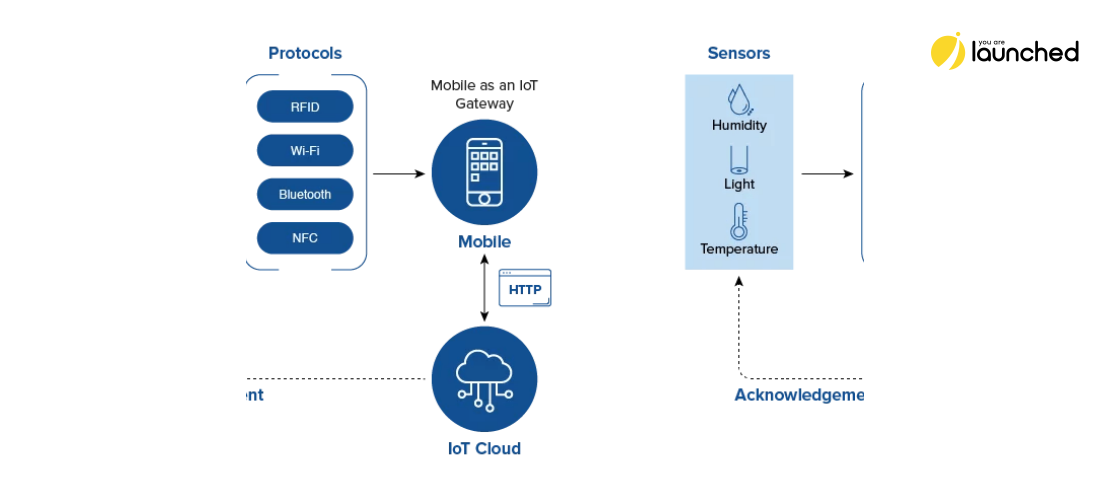
To understand why do we need all of this, let’s imagine a bare scenario and build up to the solution we have.
Scenario: Direct Link Between Sensors and Cloud
The cloud is just a storage space, and a sensor is simply hardware with limited functionality such as turning on/off. Point 1 is that a sensor is a simplistic device and should not have powerful data transmission capabilities. It would be economically unreasonable to install transmission capabilities similar to ones in phones and laptops into a sensor or indicator.
Point 2 is the amount of data. Sensors work around the clock and measure data with high frequency. Imagine a sensor that collects humidity data. What if this device sends this data every second to the cloud? The amount of data from this device will quickly grow exponentially. And if we consider how many devices we can have, it will be economically unrealistic to cater to such data volumes.
From here, we have two problems:
- We need a way to filter and package data to make it lightweight;
- We also need much more sensible data transmission options.
Considering the above, we now see why close-range protocols like NFC, Bluetooth, or RFID are much more viable solutions.
Plus, having a gateway that can control volumes of data is a must to make IoT a working option. In addition, it would be nice to not only control data volumes but also analyze it and display it to a user so that it is informative and actionable.
Why the Link From IoT Cloud To Sensors?
Ok, we see now why we need protocols and a mobile app for an IoT solution. But why do we need a link between sensors and the IoT cloud? Does it not require a more powerful transmission utility? First, the link exists mainly for security reasons. It ensures that the data comes from authorized source. For sensors, it provides certainty of data delivery. In addition, it serves as a sort of service-level agreement between the sensors and the cloud. As for data transmission, there is an MQTT protocol which stands for Message Queuing Telemetry Transport. It is a lightweight machine-to-machine protocol for basic messaging.

Key IoT Features For a Mobile App
User Authorization / User Account
It is one of the key features that almost always must be present in IoT mobile apps. It enables the following:
- Personalisation: A user can configure their devices, manage alerts, and customize their settings and preferences. The more a user can personalize their app, the higher the engagement is and the more loyal the user becomes to your app;
- Security: Authorization is an important layer of security for user data, its privacy and integrity. Additionally, authorization ensures the use of your app’s resources. If anybody can install and use your app, you may run out of cloud space and overload your system.
- User Roles: Often, IoT systems like smart homes allow several users in. Imagine a family of 4: two adults and 2 teenagers. Teenagers should be able to use their smart home too. Yet, surely, adults may want to restrict what they can do. What if they disconnect some device or sensor? What if they connect a potentially dangerous device that tampers with the system? Or, imagine a stuation when several people use one health device. You may want to allow a user to see only their data, and not of other users. To do that, it is also important to have accounts.
- Memory and Data Sharing: Data management can also depend on a user account. Since IoT apps may be data-heavy, a user should be able to select different data retention periods. In addition, a user can manage their data-sharing preferences.
- Remote access: If it is a system that allows a user to control the devices remotely, user accounts are the way to do it. Otherwise, you open the IoT system to a range of vulnerabilities and security issues.
Dashboard / Control Panel
The dashboard offers a condensed view of the entire data. Control Panel offers that plus the ability to perform some quick actions. These days, all dashboards are control panels because IoT app development always strives to empower the user. This is done by suggesting some actions and giving personalized actionable recommendations. Some examples include:
- See real-time data about energy consumption and get a suggestion about turning off some devices;
- Get a forecast and receive a suggested action on adjusting the thermostat;
- Based on the data coming from a soil moisture sensor, schedule watering of the field or crop;
- Based on real-time data of the vehicles, assign a vehicle to an empty or overloaded area;
- Get a notification about air quality and adjust the settings on the air filter;
- In a health app, there can be a sensor to measure pollen in the air and suggest actions regarding air filters. This can be a lifesaver during allergy season.
Customization Panel
This feature can encompass hardware settings, automating actions, or displaying preferences. In the customization panel, a user should be able to perform actions such as:
- Setting a lighting schedule;
- Choosing the preferred temperatures for thermostats;
- Set up special ambience for different occasions;
- Select watering schedule;
- And more.
This panel is often built with a range of sliders and toggles, input forms and dropdowns.
Some mobile IoT apps are mostly informational and its main purpose is to track data. In this case, a user should be able to set some limits or goals for each data bit or group of data. For instance, in a health app, a user might want to set some thresholds on blood glucose or heart rate during sports activities. So when the threshold is reached, user gets alerts. Another mainstream trend is to watch blood glucose levels, sleep patterns, or heartbeat. In any case, a customization panel is commonplace for any IoT mobile app.
Safety Features
Since the IoT mobile app is by design a source of user’s personal data, it requires several layers of security. Often, initial authorization is done by setting up an account with login and password. But, also, a user requires different options such as PIN, biometric authentication or the pattern lock. There might be requirements to enforce a 2-factor back-up security authorization. It is when the user is sent a message to their phone or messenger in addition to entering the password. In mobile phones, an app should recognize the extra code if the app runs on the device the code was sent to.
Contact Form / Help
Since an IoT app requires hardware and contains a lot of sensitive data, a user should have at least one way of contacting support. At least a form where a user can describe a problem and attach a screenshot. This system should send out an email in recognition of the reported issue. It also needs to suggest a response time and alternative ways of solving the problem.
For instance, a link to a help section with frequently asked questions that contain keywords mentioned in the user’s issue.
Onboarding
It is a good practice to include screens for the just-registered user to introduce the app’s capabilities. Onboarding guides users through main interactions and functionalities. So, it needs to show where a user can change settings, customize the app, and reach out for support.
It may be implemented through contextual tooltips, tutorials, guided tours of the app, or walkthroughs, etc. In general, you want to have some way of familiarizing users with the app. This ensures user engagement and involvement with the app. It can minimize possible friction or confusion. It is quite beneficial for a smooth user experience.
Modern Tech Stack to Implement Key Mobile App IoT Features
There are 4 major blocks of technologies involved in IoT mobile app development. Similar to any mobile app, there are technologies needed for frontend and backend implementation. A frontend that will display the data and navigate the user through the app. A backend that will be checking authorization, processing requests, and doing analytics. Additionally, there are technologies to implement the IoT cloud and ensure communication with the hardware.
Frontend Mobile App technologies
Since the app can be either native or cross-platform, technologies can vary. To generalize, they are:
- Kotlin for Android apps,
- Swift for iOS app, and
- React Native or Flutter for cross-platform.
Backend Technologies for IoT Mobile App Development
The regular mobile backend stack can include a variety of languages. For instance, languages such as NodeJS, Java, Ruby, or Go. In addition to a more standard mobile backend stack, there is an emphasis on analyzing large data volumes. This often calls for the use of Python.
To speed up the development, there are additional libraries and packages for more narrow tasks. For instance, communication between frontend and backend can be implemented via REST API or GraphQL which is gaining popularity. GraphQL is a newer and more performant solution. In constrast, REST API is more robust and simplistic; hence, less error-prone. However, when the data gets complex, GraphQL can offer more flexibility to request only the required data. Consequently, it is more complex in development and requires more testing.
Other libraries are:
- for authorization – OAuth 2.0, or JWT;
- for displaying complex data – Graphana, Prometheus, or ELK stack;
- for handling HTTP communication – Express.js, Django, Flask and others.
Cloud Infrastructure For a Mobile IoT App
The options here are vast as well. There are industry-standard cloud solutions such as AWS and Microsoft Azure. These two have been leading technologies for years. However, there are more novel and purpose-oriented IoT cloud solutions. They are:
- Arduino,
- IBM Watson which is AI-powered, and
- Google Cloud which is good for projects that integrate other Google solutions
Hardware (Sensors, Controllers, Accelerators, etc.)
These technologies will vary greatly from one IoT mobile app to the other.
IoT systems can consist of a couple of sensors. This IoT app development will require just several extensions for VSCode (or other IDEs).
However, more powerful solutions can include systems of sensors, devices, cameras, and more with control boards and other hardware modules. They will require special device SDKs.
Frequently Asked Questions: Build a Mobile IoT App
IoT mobile app development involves creating applications that connect and interact with IoT devices. These devices can range from home appliances and health monitors to industrial sensors and smart cities. The app collects, analyzes, and controls data from these devices, enabling users to manage them effectively.
IoT mobile apps are crucial because they provide a user-friendly interface to control and monitor IoT devices. This integration enhances the functionality and usability of IoT devices, making them more accessible and valuable in everyday life and various industries.
The architecture of an IoT mobile app typically includes sensors, a mobile device, and the cloud. Data is transmitted from sensors to the mobile device, which then sends it to the cloud for storage and processing. This architecture ensures efficient data handling and real-time monitoring.
A direct link between sensors and the cloud is not sufficient because sensors typically lack robust data transmission capabilities and generate large volumes of data. Intermediate protocols like NFC, Bluetooth, or RFID and gateways help filter and package data, making transmission more efficient and manageable.
Key features of an IoT mobile app include user authorization, a dashboard/control panel, a customization panel, safety features, a contact form/help section, and onboarding. These features ensure security, personalization, user engagement, and efficient device management.
Frontend technologies for IoT mobile apps include Kotlin for Android, Swift for iOS, and cross-platform solutions like React Native or Flutter. These technologies help create user-friendly interfaces and seamless user experiences.
Backend technologies for IoT mobile apps include NodeJS, Java, Ruby, Go, and Python. REST API or GraphQL can be used for communication between frontend and backend. Additional libraries for authorization (OAuth 2.0, JWT) and data display (Graphana, Prometheus, ELK stack) are also commonly used.
Recommended cloud infrastructures for IoT mobile apps include industry standards like AWS and Microsoft Azure, as well as specialized solutions like Arduino, IBM Watson (AI-powered), and Google Cloud. These platforms offer robust and scalable solutions for IoT data storage and processing.
IoT hardware can include sensors, controllers, accelerators, cameras, and more. The specific hardware requirements depend on the application’s complexity and purpose. Development may require extensions for IDEs or specialized device SDKs for more advanced solutions.
The main challenges include managing large volumes of data, ensuring robust security, integrating various hardware components, and maintaining efficient communication protocols. Developers must also focus on user experience and scalability.
Security is paramount in IoT mobile apps due to the sensitive nature of the data they handle. Features like user authorization, encryption, two-factor authentication, and secure communication protocols are essential to protect user data and ensure system integrity.
User onboarding is crucial as it helps users understand the app’s features and functionalities, leading to better engagement and a smoother user experience. Onboarding can include tutorials, guided tours, contextual tooltips, and walkthroughs.
Current trends include the integration of AI for enhanced data analysis, increased focus on security, the use of cross-platform development tools, and the adoption of advanced cloud solutions. These trends aim to improve functionality, user experience, and overall app performance.
Businesses can benefit from IoT mobile apps by gaining real-time insights, improving operational efficiency, enhancing customer experience, and enabling better decision-making. IoT apps can also open new revenue streams and support innovative business models.
Future developments may include more advanced AI integration, improved interoperability between devices, enhanced security measures, and the use of edge computing for faster data processing. These advancements will further enhance the capabilities and applications of IoT mobile apps.
Final Thoughts
The technological implementation of a mobile IoT app has three key elements:
- Architecture;
- Functionality;
- Technology stack.
Going into IoT mobile app development requires more moving parts than an e-commerce app or food-ordering app. For one, it includes hardware. And also, it must be more secure. It is essential to be prepared for all technological nuances when developing your IoT-based MVP app.

